
%20GIF.gif?width=200&name=HammerTech%20Intelligence%20(HTI)%20GIF.gif)

“My career in health and safety was born out of a deep desire to protect lives and ensure that every worker feels valued, heard, and safe."
~ Melvina Stacey
Safety leadership shows up on the jobsite, often before anyone calls it leadership at all.
It’s found in early conversations, in moments when plans change, and in leaders who listen, act, and are willing to adopt better ways of working to help teams build safer and more efficient projects.
The Construction Safety Excellence Awards (CSEA), hosted by AGC of California (AGC-CA) in partnership with HammerTech, recognizes individuals whose standout leadership protects workers and raises safety standards across California’s construction industry.
The 2026 honorees, industry-leading safety pros making a measurable impact across the state, were announced in October 2025.
Among them is Melvina Stacey, Health and Safety Director for the Pacific West at Flatiron Dragados, who was named ‘2026 Harry Eckstein Safety Professional of the Year’.
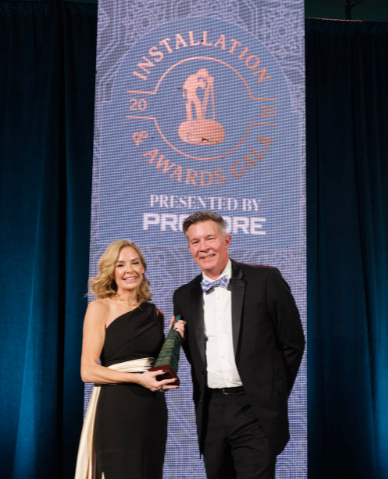
We caught up with Melvina before she received her award to reflect on her career to date, the experiences that have shaped her safety leadership, and the forces defining construction safety in 2026.
Q: Can you please introduce yourself?
A: My name is Melvina Stacey, and I’m the Health and Safety Director for the Pacific West at FlatironDragados. That responsibility spans from Washington State down to San Diego, supporting teams across a wide range of complex infrastructure and heavy civil projects.
Q: Congratulations on being named the ‘2026 Harry Eckstein Safety Professional of the Year’. What does this recognition mean to you?
A: Personally, this award is incredibly humbling. My career in health and safety was born out of a deep desire to protect lives and ensure that every worker feels valued, heard, and safe. Early in my career, I saw first hand how a preventable incident could permanently change lives, and that reality never left me.
This recognition represents far more than an individual achievement. It reflects the collective efforts of the people I’ve had the privilege to work alongside throughout my career.
Professionally, it reinforces my belief that safety leadership is rooted in trust, accountability, and compassion. Harry stood for workers and that aligns deeply with how I lead. Strong safety leadership goes beyond preventing harm. It builds morale, strengthens teams, and drives excellence across an organization.
Q: What was your reaction when AGC-CA told you of your win?
A: Of course I was excited, but genuinely taken aback! I’m originally from Canada and have been working in the U.S. for just under four years. So being relatively new to California made the recognition even more unexpected.
I’ve worked across many industries, including infrastructure, heavy civil, oil and gas, mining, and nuclear power. That breadth of experience exposed me to different approaches to hazard management, leadership, and safety culture, which has shaped how I approach my role today at FlatironDragados.
Q: What life experiences have shaped your approach to safety leadership today?
A: There was a life-altering moment early in my career that permanently shaped my approach to safety. When I was 21 years old, I was involved in a motor vehicle accident while returning home from work at an oil refinery. A dear friend of mine, Andrew Burns, lost his life that day. He was a talented surveyor, known for his kindness. He was only 33 years old.
Losing him brought the real human cost of safety failures into sharp focus. From that moment on, safety became a personal mission, not just a profession. My leadership has been driven by accountability and compassion, not just policies and procedures.
Q: What do you think are the most important forces shaping health and safety in construction in 2026?
A: I actually love this question! One of the most significant forces is the evolution of leadership accountability. Safety can no longer be delegated to a department or function. Owners, executives, and project leaders are increasingly being held accountable for safety outcomes, not just in the field, but in planning, scheduling, procurement, and execution.
The most impactful safety decisions are made long before a worker ever steps onto a jobsite.
At the same time, data analytics and technology are fundamentally changing how we manage risk. We’re moving from reactive approaches to predictive ones by tracking leading indicators, analyzing trends, and applying predictive models. Integrated digital platforms, real-time monitoring, wearables, and automation in safety training are helping us reduce exposure and improve situational awareness on complex projects.
Ultimately, the goal is to remove people from hazards wherever possible by applying the hierarchy of controls.
Q: What should safety leaders be mindful of as technologies like AI become more common in North American construction?
A: Technologies, including AI, have enormous potential to support safety leadership through predictive risk modelling, real-time data analysis, and smarter training approaches like virtual reality. These tools help us identify patterns, prioritize resources, and intervene earlier.
That said, tech must remain an enabler, not a replacement for leadership. Data still needs to be translated into action, and human judgment remains essential.
The most successful organizations will be those that blend smart technology with strong leadership and a people-first mindset.
Q: How are the expectations of construction safety leaders changing across the industry?
A: Safety leaders are increasingly expected to serve as strategic partners, not just technical experts. We need to understand the business, influence decisions at the executive level, and embed safety into planning, design, and operations rather than managing it as a standalone function.
There’s also a growing expectation to lead diverse teams across multiple locations and create psychological safety where people feel empowered to speak up. That requires emotional intelligence, adaptability, and the ability to translate data and insight into clear, attainable actions in the field.
When systems and leadership are aligned, safety becomes a shared responsibility instead of a compliance exercise.
Q: What does meaningful safety leadership actually look like in practice for workers on site?
A: For craft workers, meaningful safety leadership is very tangible. It’s leaders who are present in the field, who actively listen, and who follow through when concerns are raised.
When workers see that their ideas lead to real improvements and that their experience matters, safety stops being a compliance exercise and becomes a shared value. That trust and inclusion are what sustain a strong safety culture on site.
Q: Where do you see the greatest opportunity for safety leaders to make a real difference over the next few years?
A: The greatest opportunity lies in embedding safety earlier and deeper into the project lifecycle, during design, pre-construction, and work planning. When safety is integrated at these stages, we eliminate risk rather than manage it later.
Another major opportunity is developing leaders at every level. Frontline supervision has the greatest influence on daily risk decisions. Investing in their development and empowering workers to co-create solutions is where we see the most sustainable improvement. Cultures are built through relationships, not rules.
Q: What gives you confidence about the future of health and safety in construction?
A: What gives me confidence is the progress we’re seeing in how the industry values people. There’s a growing focus on well-being, inclusion, and diversity of thought. When people are given a purpose, they naturally look for ways to bring it to life, and safety is one of the most powerful purposes we have.
For emerging safety leaders, my advice is simple: don’t let the numbers or challenges discourage you. Let them motivate you. Spend time in the field, build relationships, stay curious, keep learning, and lead with integrity, empathy, and courage.
Confidence grows with experience, but purpose starts now.
For more information on the CSEA: https://www.prnewswire.com/news-releases/agc-of-california-honors-safety-excellence-winners-announced-at-38th-annual-construction-safety-excellence-awards-302597531.html
--
About FlatironDragados
Sector: Heavy civil construction and infrastructure
Focus: Transportation, water and wastewater, resiliency protection, tunnelling, and complex infrastructure projects.
Footprint: U.S. and Canada
Size:
>$6.5B in annual revenue
>$16B order backlog
Parent company: ACS Group, one of the world's leading infrastructure companies
.png)