
%20GIF.gif?width=200&name=HammerTech%20Intelligence%20(HTI)%20GIF.gif)

Artificial intelligence has quickly become part of the construction industry’s daily vocabulary, from chatbots that answer quick questions to image recognition that flags PPE non-compliance.
But between bold claims and pilot projects, one question remains: How much of AI in construction safety is real progress, and how much is still hype?
For safety directors and operations leaders, the answer matters.
The coming years will determine whether AI becomes a real partner in preventing incidents or just another disconnected tool in the tech stack.
What's Inside |
The State of AI on Today’s Jobsites
AI has already arrived in construction safety, though its footprint varies widely.
Contractors are experimenting with:
-
Computer vision tools that identify unsafe behaviors or PPE violations
-
Wearables that monitor worker fatigue or location
-
Large language models (LLMs) used for form completion or quick data lookups
These early steps are promising. But they also reveal the industry’s biggest challenge: fragmented data.
Each “point solution” captures a small piece of the safety puzzle — images, checklists, readings — but rarely connects with the larger system where safety decisions are made.
"AI is all about data, but it only delivers real value when that data is contextual, deliberate, and connected - tied into the processes that workers and leaders rely on each day.”
 Andrew Barron, Chief Product Officer

Many contractors see potential but remain cautiously optimistic. Until AI tools integrate into day-to-day safety workflows, adoption will stay slow.
From Point Solutions to Platform Intelligence
AI is At HammerTech, our AI philosophy is simple: start with the worker, not the algorithm.
AI should reduce the friction that crews face every day, not add more screens, logins, or complexity. This principle underpins the evolution of HammerTech Intelligence, designed to embed AI directly into the workflows safety teams already use.
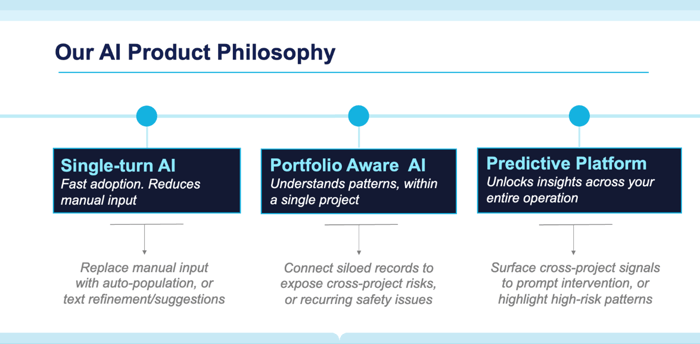
Here’s how AI is progressing across three key stages of maturity:
Stage One: Single-Turn AI (Today)
Using large language models to automate simple, repeatable tasks.
Example: When a superintendent attaches a photo to a safety observation, AI can instantly analyze and classify the issue — identifying, describing, and tagging it with structured data.
-
Faster and more accurate than manual entry
-
Eliminates vague inputs
-
Builds higher-quality data for analysis later
Stage Two: Process-Aware AI (Emerging)
AI begins connecting dots across projects and datasets, surfacing correlations and trends that humans may not spot.
Example: Automated summaries of site diaries, daily reports, or safety observations across multiple sites — showing leading risk indicators at project or enterprise level.
-
Turns data into actionable insights
-
Reveals systemic risks before they escalate
-
Helps leaders prioritize resources effectively
Stage Three: Anticipatory Platform Intelligence (Next)
Anticipatory intelligence, what some may consider the ‘holy grail’ of AI, can benefit construction safety too — with the proper consideration.
By analyzing years of structured, connected data — incidents, permits, injuries, observations, and more — AI can forecast where and when risks are most likely to emerge.
Example: Dashboards that alert teams to elevated risk conditions based on historical patterns and real-time inputs.
This anticipatory capability isn’t built overnight. It requires a foundation of clean, connected data and tools that are adopted consistently in the field.
Why Safety Leaders Are Leaning In
Safety leaders across the globe are asking practical, grounded questions:
-
Can AI take routine paperwork off crews’ plates?
-
Can it speed up reporting and improve accuracy?
-
Can it help surface risks before incidents occur?
The answer is increasingly yes, but with a critical caveat: AI must assist workers, not replace them.
(Done right) AI should:
-
Be built-in, not bolted on
-
Work seamlessly within existing workflows
-
Reduce admin, not create it
-
Provide context, not just data
-
Help safety professionals focus on people, not paperwork
AI’s real promise is giving site teams the visibility and foresight to act faster and with more confidence, not replacing human judgement.
Real-World Example: Observation Photo Recognition
One of the most time-consuming tasks for safety teams is documenting field observations. Some workers type long, detailed notes; others enter only a few words. That inconsistency makes analysis difficult and slows reporting.
AI can now automatically interpret a photo or short text, classify the observation, and generate a full, structured entry, saving time while improving data quality.
The benefits ripple outward.
-
Accuracy: Standardized, detailed descriptions
-
Speed: Seconds instead of minutes per observation
-
Anticipatory Potential: High-quality data that feeds future analysis
This isn’t theoretical, it’s happening now. Contractors using AI-assisted observation entry are already reporting faster closeout cycles and more reliable safety metrics.
Video: HammerTech Intelligence (AI) filling in key observation fields based on what it sees — so your crews don't have to.
Building the Foundation for Predictive Safety
Predictive intelligence is only as strong as the data beneath it.
That’s why the future of AI in construction safety hinges more on field adoption and less on new algorithms.
When safety data is captured consistently, in a connected platform, AI can finally deliver the insights leaders have long wanted.
-
Which hazards drive the most incidents?
-
Where are safety conversations declining?
-
Which subcontractors are most compliant—and most at risk?
"AI won’t be something you roll out once. Like cloud, it will just become how things work. The question is how much friction and waste you want to tolerate along the way."
Andrew Barron, Chief Product Officer
The Road Ahead: From Efficiency to Foresight
We’re still early in AI’s construction safety journey, but the direction is clear. The most successful contractors will be those who:
-
Centralize their safety data within connected platforms
-
Automate routine processes to free field time
-
Invest in structured data quality to enable predictive insights
-
Empower, not replace, the professionals who keep people safe
AI isn’t replacing the safety manager; it’s giving them better tools to lead.'