
.png)
For years, contractors have invested heavily in project management, ERP, and HR technology i.e. systems now considered essential for running a modern construction business.
Yet safety, often cited as a company’s “number one priority”, still struggles to occupy that same strategic tier.
What's Inside |
On job sites across North America, safety managers still juggle clipboards, spreadsheets, and half-connected tools just to stay compliant.
In fact, 67% of construction employees believe standards for productivity are higher than those of safety.
It’s not because safety pros lack commitment. Their tools just haven’t kept up.
Project management, ERP, and HR systems have evolved into enterprise platforms. But safety has been left behind, siloed in disconnected apps that limit visibility, delay response, and weaken culture.
The solution isn’t more digital forms. It’s integration.
Safety deserves the same technological depth and intelligence as any other core business system — one that connects every worker, trade, and process in real time.
If safety truly is a top priority, it deserves the same technological investment and integration as any other core business system.
“Procore is great for project management, but to meet our company-wide safety goals we needed a dedicated solution, that’s why we chose HammerTech.”
Joshua Bullock, CHST

The Case for Elevating Safety
Safety isn’t a checklist or a compliance exercise, it’s a complex, interconnected workflow that underpins productivity, reputation, and profitability. Every leading indicator, from pre-task planning to inspections and training, affects outcomes across the business.
Depth and integration are what distinguish mature safety programs from reactive ones.
Safety must function as a connected platform, where every process, document, and data point flows seamlessly between people and systems.
Field Teams Failed by Fragmented Tools
Field leaders face a unique challenge: balancing production schedules with risk management. Studies show that the average contractor processes more than 350 safety-related transactions each day — from worker orientations to permits, inspections, and incident reports.
When these processes rely on paper or disconnected systems, critical information is lost or delayed. Teams spend time chasing signatures and uploading documents instead of managing actual safety risks.
The result is fatigue, inconsistent data, and a focus on administrative tasks instead of prevention.
Even well-intentioned digital tools can fall short when they’re not built for the realities of safety management.
A project management platform may offer surface-level safety features, but it’s designed for general coordination, not for the depth, structure, and compliance rigor that true safety workflows demand.
Purpose-built safety platforms go far deeper, connecting every workflow and stakeholder needed to keep projects genuinely safe.
“Procore excels at overall end-to-end project management but lacks efficient site sign-in capabilities. HammerTech fills that critical gap…
Both systems integrate seamlessly, feeding valuable data into our data lake to support predictive analytics and real-time decision influencing.”
 Tomas Hollingsworth, Director of Technology

Safety as an Enterprise Platform
True safety maturity requires enterprise-level infrastructure, tools that connect field teams, subcontractors, and leadership through structured, standardized workflows.
A dedicated safety platform should:
-
Integrate seamlessly with core business systems (project management, ERP, HRIS) through open APIs.
-
Provide unlimited access so every worker and trade partner can contribute to safety without licensing barriers.
-
Deliver structured safety data, turning field actions into analytics that inform proactive decision-making.
-
Be configurable for different project types, from commercial builds to data centers and civil infrastructure.
-
Support enterprise readiness, with scalability, security, and performance standards that meet the needs of top ENR contractors.
In short, a safety platform should function as the operational core for risk management — just as ERP or accounting solutions do for finance or project management tools for operations.
Safety Outcomes = Business Outcomes
Safety technology isn’t just about preventing injuries but enabling stronger business performance. Contractors with well-structured safety programs consistently report advantages in three key areas:
-
Controlling risk: Managing risk is critical, a dedicated safety platform gives you the tools to visualize and take action to minimize safety risk.
-
Winning work: A strong safety record enhances your reputation with clients and owners, helping you prequalify faster, stand out, and win more work.
-
Attracting talent: In an industry plagued with labor shortages, a strong safety culture and modern technology make you the contractor of choice for workers and trade partners.
These aren’t aspirational claims; they’re proven differentiators among high-performing contractors across North America and beyond.
According to Associated Builders and Contractors (ABC, 2024), contractors using integrated safety systems report 20% fewer recordable incidents than those using traditional methods.
Addressing the Hesitation to Invest
Many construction leaders agree safety is vital but hesitate to adopt dedicated platforms, often assuming that existing project management tools can fill the gap. In reality, those tools are optimized for scheduling, documentation, and coordination, not for the nuances of risk control or regulatory compliance.
Bundled safety modules tend to treat incidents, inspections, and orientations as static forms rather than dynamic workflows. They don’t capture the depth or relational data safety teams need to measure trends, assign accountability, or continuously improve.
“The biggest difference is real-time collaboration and accountability. Site teams no longer rely on paper processes — everything from inspections to RFIs to RAMS are instantly visible to the wider team, streamlining communication and improving safety and quality outcomes.”
 Laura McCooey, Group Quality & Environmental Manager

Waiting to “see what other systems do for safety” means staying reactive in an area where every delay carries human and financial cost. Forward-thinking contractors are now recognizing that safety technology is business technology, an enabler of consistency, efficiency, and confidence across their operations.
Building the Case for Change
For organizations still weighing the investment, the path forward mirrors any other enterprise technology adoption.
Consider three practical steps.
-
Assess your current state: Identify where manual or disconnected processes create risk or delay.
-
Quantify impact: Evaluate the cost of inefficiency, from lost time to potential claim exposure.
-
Align stakeholders: Safety, operations, and IT leaders should collaborate on defining the value of a unified platform.
As outlined in A Comprehensive Buyer’s Guide to Construction Safety Software, contractors that digitize safety processes not only improve compliance but also see measurable ROI in productivity, insurance savings, and workforce engagement.
Safety: The Industry’s Next Table Stake
The future of construction belongs to teams who treat safety as infrastructure, not overhead. By connecting data, people, and processes through an enterprise safety platform, contractors gain what spreadsheets and bolt-ons can’t: true visibility, accountability, and foresight.
Contractors already investing in dedicated safety technology are seeing measurable gains — fewer recordable incidents, higher worker engagement, and faster onboarding times.
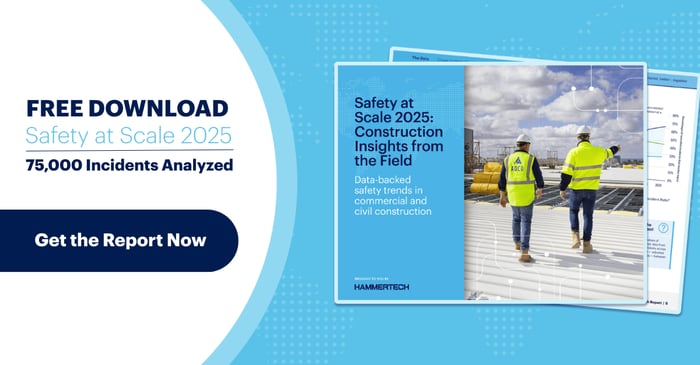
But the real impact runs deeper: stronger culture, greater trust, and safer, more productive job sites.
Safety deserves the same level of infrastructure, investment, and innovation as any other critical business system. Because the cost of not doing so is measured in more than dollars.
Summary
Elevating safety means aligning culture, technology, and accountability across every level of the organization. The most advanced contractors already view their safety platform as the digital backbone of their operations, a single source of truth for every worker, trade, and site.
Safety isn’t a department, a document, or a dashboard. It’s a connected system for protecting people and driving performance.
If safety is your top priority, it deserves a platform built for it.
.png)