
“One of my biggest goals was to make this feel familiar to everybody. The initial feedback has been great. We haven’t seen a lot of hiccups or complaints.”
.jpg?width=101&height=101&name=Shawn%20Dygd_Suffolk%20Construction_Headshot_lower%20res%20(2).jpg)

What's Inside |
Summary
On large, multi-trade commercial builds, safety systems must move at the speed of the jobsite. Crews need to log issues quickly. Safety leaders need visibility across projects. Subcontractors must operate from the same source of truth.
For many general contractors, fragmented tools and paper-based processes make that nearly impossible.
The result? Construction safety management software is becoming even more critical to manage safety at enterprise scale.
For Suffolk Construction, a national contractor managing complex projects across the United States, disconnected safety tools were limiting visibility and consistency.
As the enterprise builder, known as 'America's Contractor', continued to scale, leadership recognized that fragmented workflows and siloed data would not support a unified, enterprise-wide safety strategy.
“Our goal was to get all our safety platforms into one application. We wanted to go digital, remove some of the administrative burden, and make safety more effective and efficient out in the field.”
This shift reflects a broader move toward digital safety transformation, where construction data analytics and real-time visibility support safer, more consistent project delivery.
Executive Snapshot: Suffolk Construction

Specialties: Preconstruction, building information modeling (BIM), construction management, vertical construction, virtual design and construction (VDC), and general contracting.
Size: 3,500+ employees; $10 billion+ annual revenue.
Location: Headquartered in Boston; offices in New York City and Westchester County, New York; Estero, Miami, Tampa and West Palm Beach, Florida; Dallas; Los Angeles, Milpitas, San Francisco and San Diego, California; Las Vegas; Portland, Maine; New Haven, Connecticut; Herndon, Virginia; and Salt Lake City.
Timeline: Founded by Suffolk Chairman and CEO John Fish in 1982; joined the HammerTech Community in early 2025.
Early Impacts on Site
-
Consolidated multiple safety workflows in one end-to-end digital platform
-
Successful initial rollout on a live, complex, high-rise commercial project
-
Increased visibility of jobsite safety trends for regional leadership
-
Created structured, data-informed conversations with subcontractors
-
Reduced admin friction for frontline site teams
-
Improved subcontractor safety compliance through shared digital workflows
An end-to-end platform for daily site realities
Like some large enterprise contractors, Suffolk had accumulated multiple safety tools over time, rather than operating from a single construction safety management software platform.
Different systems handled different workflows. Reporting required coordination across platforms. Information often lived in separate locations, limiting the impact of construction data analytics across multiple of projects.
The impacts on site teams? Less duplicate entry and time spent tracking down paperwork.
Safety leaders can see what has been completed and what still needs attention without chasing multiple systems.
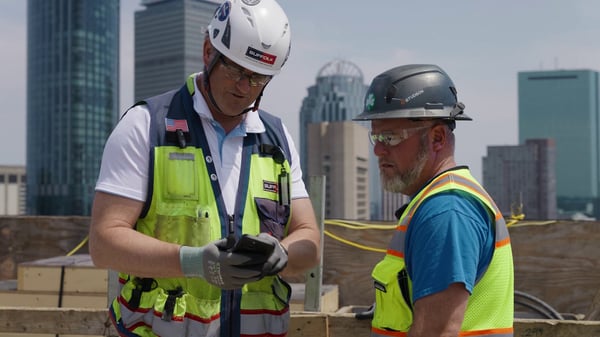
The Huntington Tower project in Boston served as the first rollout location. Teams tested multiple modules under live jobsite conditions.
“It was one of the first projects where we were able to use all the different modules,” Shawn says, including incident reporting, orientations, observations, inspections, and pre-task plans.
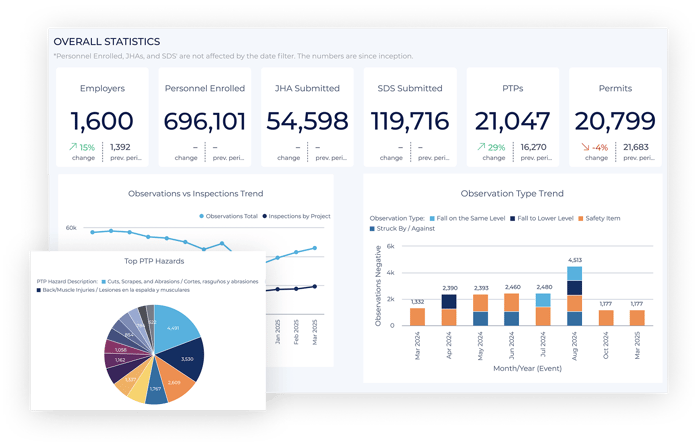 Shawn says usable data that can be shared with subcontractors is critical for Suffolk.
Leveraging construction data analytics for safer, smarter, faster decisions
Every project generates safety information. Job Hazard Analyses. Pre-Task Plans. Inspections. Observations. Incident reports. This volume is familiar on any large build. What matters is whether that information influences decisions while work is underway.
"Data is a huge part of everything that we do at Suffolk. We’re really trying to pinpoint information that we can share with our subcontractors so they understand what our concerns are on site.”
When subcontractors can see the same trends Suffolk sees, discussions become more focused. Crews begin referencing specific trades, specific tasks, and specific areas of the site that require attention that week.
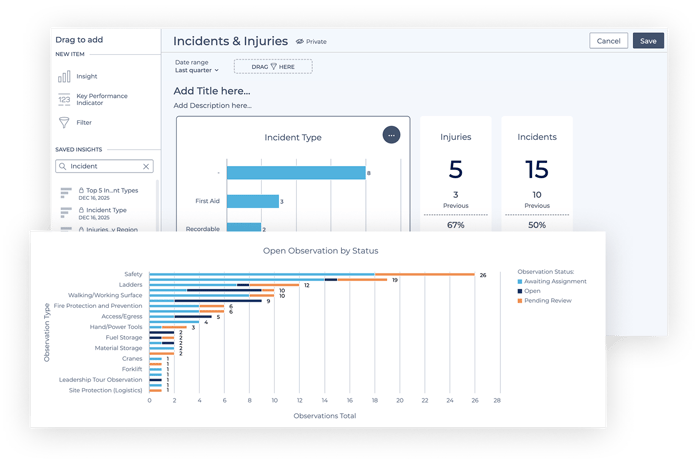
Those conversations tend to happen earlier in the work cycle. Supervisors can reinforce controls, sequencing can be adjusted, and extra eyes can be put on higher-risk activities before issues escalate.
"In reality, we want people to go home to their friends, their family, and their loved ones, in the same way they showed up.”
Improving subcontractor safety compliance across jobsites
Subcontractor engagement remains one of the toughest challenges in construction safety. Each company arrives with its own documentation processes and habits. Alignment requires structure. Site teams live it daily.
“One of the big things we’re really looking forward to is getting our subcontractors involved. The nice thing about this product is there’s no cost to the subcontractor.”
Removing that barrier lowers resistance.
When subcontractors use the same digital site safety system, communication becomes more consistent. Observations are easier to track, expectations are visible, and follow-ups are clearer.
Want to learn how North America's leading contractors manage enterprise safety at scale?
Visit https://www.hammertech.com/en-us/product/platform for more information.