Risk Assessment and Method Statement (RAMS)

    A Risk Assessment and Method Statement (RAMS) is a critical safety document in UK construction that outlines site-specific hazards, control measures, and safe systems of work.

    RAMS help protect workers, support compliance with UK health and safety regulations, and meet client expectations—especially on high-risk tasks. Whether you're looking to define RAMS, understand how they work, or need a free RAMS template, you’re in the right place.

    Why Are RAMS Important in Construction?

    Icon of a caution sign with downward arrows for

    Reduce Risk

    Clearly identify site-specific hazards and control measures before work begins—preventing injuries and costly delays.

    Icon of two chat bubbles and people, communicating over a gear box and check mark. This represents

    Improve Safety Coordination

    RAMS provide all workers and subcontractors with a clear, step-by-step breakdown of what’s happening, when, and how to do it safely.

    Icon of a

    Meet Health & Safety Expectations

    Though not legally required, RAMS are often requested by clients and demonstrate due diligence under UK health and safety laws.

    Learn: What is RAMS in Construction?

    Curious about what RAMS means or how it improves your site safety? A RAMS document helps you plan work more safely by clearly identifying potential hazards and setting out exactly how tasks should be carried out.

    It combines a Risk Assessment (what can go wrong and how to prevent it) with a Method Statement (how the work should be done safely). RAMS are essential for tasks like hot works, working at height, and confined space entry.

    Download the free RAMS Template and start improving safety and compliance today.
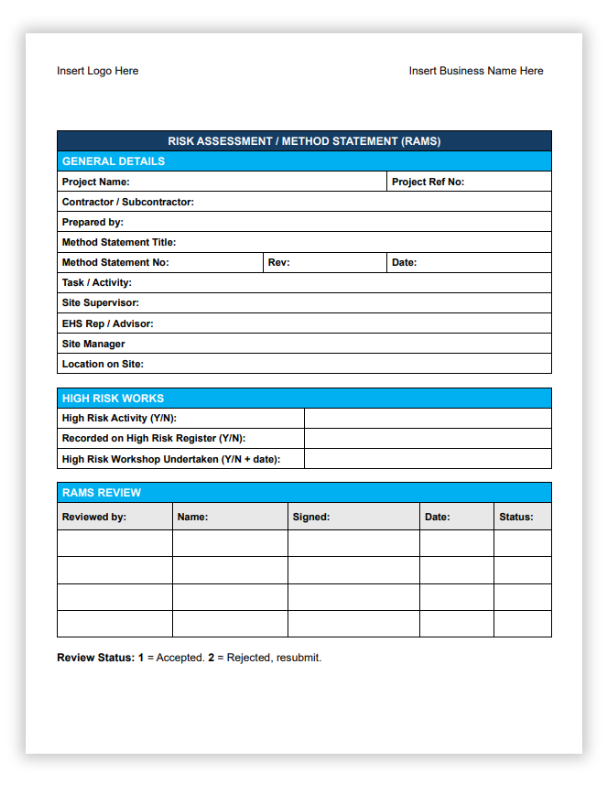
    Cover page of the fillable RAMS template and Risk Assessment and MAC tool

    FAQs: Risk Assessment and Method Statement (RAMS)

    What is a RAMS document?


    A RAMS document is a combined Risk Assessment and Method Statement used in UK construction to identify hazards and outline safe work procedures.


    RAMS explain both what the risks are and how to manage them.


    The risk assessment identifies potential hazards and evaluates their likelihood and impact.


    The method statement describes step-by-step how to safely carry out the task, including controls and responsibilities.


    RAMS are widely used in construction and other high-risk industries to improve safety, planning, and compliance—even though not legally mandated.

    What does RAMS stand for?


    RAMS stands for Risk Assessment and Method Statement.


    This acronym represents two key parts of a single safety document:


    • Risk Assessment: Lists job-specific hazards, who might be harmed, and how to control the risk.

    • Method Statement: Describes how the work will be carried out safely and step-by-step control measures.

    Are RAMS legally required?


    RAMS are not a legal requirement in name—but their components are required under UK safety law.


    The Health and Safety at Work Act 1974 and CDM Regulations 2015 require employers to assess and manage risks. RAMS are one of the most effective ways to show you've done that. While the law doesn’t demand a “RAMS” document specifically, many clients do—especially for high-risk activities.

    Who prepares RAMS?


    RAMS are typically prepared by the employer or principal contractor—but input from supervisors and experienced workers is essential.


    A RAMS document should be task-specific. While the contractor is responsible for creating it, it’s best developed collaboratively with team members familiar with the task at hand. This ensures the method is practical, hazards are identified, and control measures are relevant.

    When should RAMS be used?


    RAMS should be used for high-risk tasks or whenever a client or principal contractor requires them.


    They are commonly expected for:

    • Working at height

    • Hot works (e.g., welding, cutting)

    • Confined space entry

    • Lifting operations

    • Hazardous substance use

    • Electrical work

    • Demolition activities


    Using RAMS helps manage risk and plan work more effectively before boots hit the ground.

    Why are RAMS important in construction?


    RAMS help prevent injuries, improve planning, and promote a culture of safety.


    They provide a structured process for identifying risks and communicating safe methods of work to all site personnel. RAMS also:


    • Enhance communication between contractors and trades

    • Improve efficiency by clarifying responsibilities

    • Help meet legal obligations under UK regulations

    • Serve as proof of due diligence if something goes wrong

    What’s the difference between a Risk Assessment and a Method Statement?


    A Risk Assessment identifies hazards and how to reduce the risk. A Method Statement explains how the job will be done safely.


    Think of it like this:


    • The risk assessment answers: What could go wrong, and how bad would it be?

    • The method statement answers: What’s the safest way to do the job?


    Together, they create a RAMS document that both anticipates problems and outlines practical solutions.

    Additional Resources

    Cutout of grayscale construction workers looking at a tablet together, discussing RAMS, with a RAMS template in the background over dark blue HammerTech background
    Blog

    RAMS in Construction: The Essential Guide to Risk Assessments and Method Statements

    10-Minute Read

    In construction, risk isn't optional — but planning for it is.

    You’ve seen it before. A crew shows up, tools in hand, ready to start th...

    Go to article

    A Conack construction completed building, the Meira GTx in Ireland.
    Customer Story

    Conack's Safety Revolution with HammerTech

    7-Minute Read

    Conack Construction, an Irish industry leader, embraced HammerTech's digital platform to boost safety and efficiency. Responding to grow...

    Read their story
    Front cover of Buyer's Guide for HSEQ software - ANZ/AU
    Guide

    Buyer's Guide to Construction Safety Software

    Adopting EHS technology can also streamline your operations, increase productivity, and save costs in the long run. Learn the benefits of using an HSE...

    Get your guide