%20GIF.gif?width=200&name=HammerTech%20Intelligence%20(HTI)%20GIF.gif)

-1.png)
In construction, risk isn't optional — but planning for it is.
You’ve seen it before. A crew shows up, tools in hand, ready to start the job — but something’s off. No one’s quite sure where to set up. The scaffold isn’t where it was supposed to be. The lift plan’s still sitting in someone’s inbox. One person thinks it’s a two-man job, another thinks five. Everyone’s moving — but no one’s aligned.
That’s how incidents happen.
Not from bad intentions — from unclear plans, missing steps, and assumptions made in the rush to get started.
That’s where RAMS come in.
Not just another document to file away — but a shared understanding before anything moves. A clear answer to the question: “What are we doing, and how are we going to do it safely?”
This is your guide to making RAMS actually work — where boots are muddy, radios are crackling, and there’s no room for guesswork.
What's Inside |
|
|
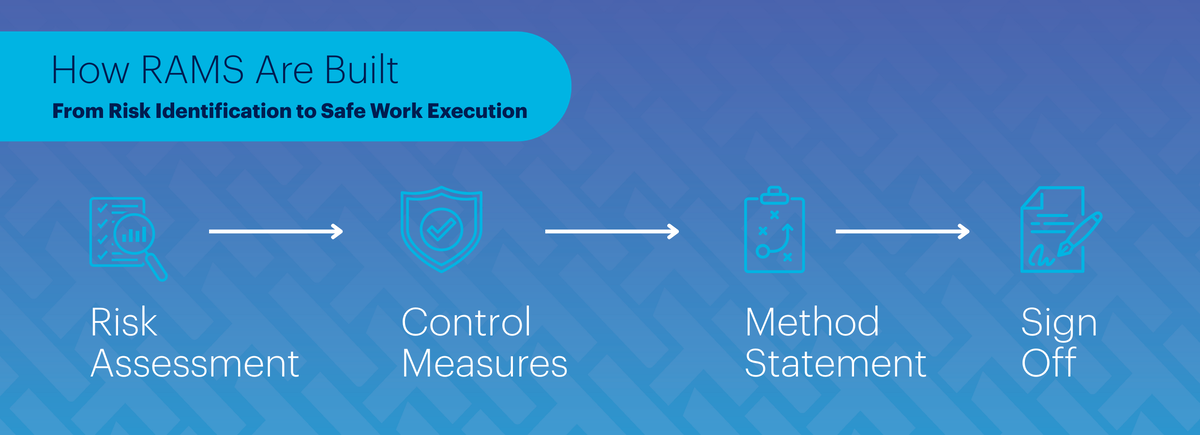
RAMS = Risk Assessment + Method Statement
Some organisations treat risk assessments and method statements as separate entities. But a combined document, or RAMS, is increasingly preferred for its practicality and clarity.
Let’s break it down.
-
Risk Assessment: A systematic process of (1) identifying hazards (anything that could cause harm) and then (2) evaluating the likelihood and severity of harm occurring.
It answers: "What could go wrong, and how bad could it be?"
-
Method Statement: Once risks are identified, a method statement steps in. This document meticulously details how a specific task or operation will be carried out safely, considering identified hazards and outlining the control measures to mitigate those risks.
It answers: "How will we do this job safely?"
-
RAMS (Risk Assessment and Method Statement): RAMS combines both to form a single, clear, coherent safety document that (1) assesses the risks associated with a task and (2) provides a clear, step-by-step method for safely executing that task.
What is the point of RAMS?
RAMS go beyond box-ticking – they’re impactful must-haves that drive safety, clarity, and control on site.
 When RAMS are clear, relevant, and actually used,
-
Prevent Accidents Before They Happen: This is the core purpose. By identifying hazards and laying out control measures, RAMS help you ask “what if?” before those risks turn into real incidents. Proactive planning prevents injuries — and saves lives.
-
Improve Communication and Clarity: A good RAMS reads like a shared language on site. Everyone — from subcontractors to site managers to clients — understands the task, the risks, and how to do the job safely. That clarity reduces confusion, missteps, and shortcuts.
-
Reduce Downtime and Delays: Productivity suffers when incidents or miscommunication strike. Robust RAMS minimise those disruptions by keeping your teams aligned, informed, and ready so projects stay on track and on budget.
-
Demonstrate Legal Compliance and Due Diligence: If an incident occurs or an HSE inspector calls, well-prepared RAMS show you’ve done your part. They serve as documented proof of your risk assessments and safety measures — reinforcing your legal and moral responsibilities.
-
Maintain Consistent Safety Standards: Whether you’re managing one team or ten, RAMS ensure every crew works to the same high standard whether you’re managing one team or ten. Such consistency strengthens your safety culture and protects your people.
-
Build Professionalism and Trust: Clients and principal contractors value a proactive approach to safety. Well-executed RAMS build trust and reputation, highlighting you are a competent, responsible, and professional contractor.
Bottom line? RAMS reflect how seriously you take your people, your projects, and your professional reputation. When done right, they don’t just meet expectations — they set the standard.
‘Do I Need a RAMS?’ – Common Use Cases
The principle of risk assessment applies to all work. But RAMS are particularly crucial for tasks that carry higher inherent risks. If the job could reasonably result in serious injury, ill-health, or significant legal consequences – create a RAMS.
Here are common scenarios where RAMS are typically required:
-
High-Risk Construction Activities
-
Working at height (e.g., scaffolding, MEWPs, roofing)
-
Excavation work (e.g., trenching, shoring)
-
Using heavy plant and machinery (e.g., cranes, excavators)
-
Demolition work
-
Electrical work and working near live services
-
Hot works (e.g., welding, grinding)
-
-
Tasks Involving Hazardous Substances
-
Asbestos removal
-
Handling chemicals, solvents, or specialist coatings
-
Working with silica dust (e.g., cutting concrete)
-
-
Work in Confined Spaces
-
Entering sewers, tanks, or underground chambers
-
-
Working with Specialist Equipment
-
Activities requiring specialised tools or techniques not routinely used.
-
-
Subcontractor Activities under CDM Regulations
-
Principal contractors must ensure all subcontractors on a project have appropriate RAMS in place to demonstrate competence, safe working.
-
Projects with Multiple Trades Working Simultaneously
-
Clear RAMS prevent clashes, minimise cross-over risks, and ensure coordinated safety efforts across different teams.
But are RAMS a Legal Requirement?
Strictly speaking, RAMS themselves are not a specific legal requirement in the UK or Ireland. However, health and safety laws in both countries require employers and duty holders to assess risks and implement control measures to protect workers.
The UK: Employers must carry out suitable and sufficient risk assessments for work activities and put appropriate control measures in place under the Health and Safety at Work etc. Act 1974 and the Management of Health and Safety at Work Regulations 1999.
-
Under the UK’s Construction (Design and Management) Regulations 2015 (CDM Regulations) for example, principal contractors will almost certainly demand a signed-off RAMS document before work can commence. Without a RAMS, you won’t get on site. Simple as.
Ireland: Employers are legally required to assess workplace risks and put written safety statements in place under the Safety, Health and Welfare at Work Act 2005. RAMS often form part of these safety statements or are used as standalone task-specific documentation.
The bottom line.
UK or Irish legislation may not mention RAMS verbatim. But RAMS help organisations demonstrate compliance, protect workers, and provide clear, site-specific safety plans. In short, they have become best practice — especially for high-risk activities like construction — as a consolidated way to help meet legal duties and communicate them on site.
How to Create a RAMS document – Step-by-Step
Key Elements for RAMS Success
A RAMS document should be more than paperwork — it should be a living, practical guide that people on site can actually use.
Site-Specific: A generic template can help you start, but every RAMS must be tailored to the actual site conditions, environment, and the specific risks of the task at hand.
Write in Plain English: Ditch the jargon. RAMS should be easy to read and understand — by everyone on site, regardless of role or background.
Make it Relevant: Focus on the exact job being done and the people doing it. Consider worker competencies, specific responsibilities, and any training needs.
Review and Update Regularly: RAMS aren’t set-and-forget. They should be reviewed whenever conditions change, new hazards appear, or an incident occurs — keeping the plan accurate and effective.
What to Include in a RAMS?
-
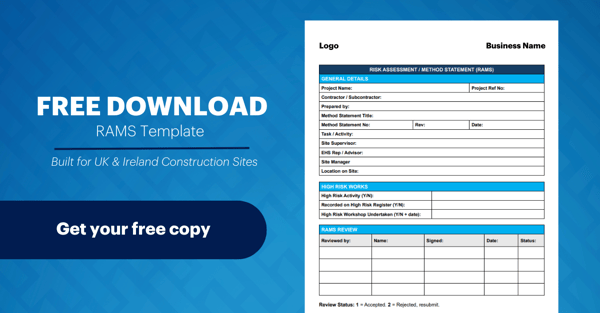
Project and Company Details
-
-
Project name and location
-
Company undertaking the work
-
Names of those preparing and reviewing the RAMS
-
Date of preparation and last review
-
Task start date and estimated completion date
-
-
Task Description
-
-
A clear, concise summary of the job — what does it involve from start to finish?
-
-
Hazard Identification
-
-
List anything that could potentially cause harm during the task. Think about:
-
Environment (e.g., slippery surfaces, poor lighting)
-
Equipment (e.g., unguarded machinery, damaged cables)
-
Substances (e.g., dust, chemicals)
-
People (e.g., untrained workers, other trades nearby)
-
Processes (e.g., lifting loads, working at height)
-
-
-
Risk Assessment
-
-
For each hazard, assess:
-
Likelihood: How likely will harm will occur?
-
Severity: How serious would an outcome be?
-
-
Top Tip: Use a basic risk matrix (low/medium/high) to prioritise actions.
-
-
Control Measures (Hierarchy of Control)
-
-
Outline what actions will be taken to eliminate or reduce each risk. Following this order:
-
Eliminate – Can the hazard be removed entirely?
-
Substitute – Can a safer alternative be used?
-
Engineering Controls – Can physical changes be made?
-
Administrative Controls – Can safer procedures be introduced?
-
PPE – As a last resort, what protective gear is needed?
-
-
-
Work Method Statement (Safe System of Work)
-
-
A step-by-step guide to completing the task safely, incorporating all control measures. It should be logical, clear, and leave no room for confusion.
-
-
Emergency Procedures
-
-
What happens if things go wrong? Include:
-
First aid arrangements
-
Fire procedures
-
Evacuation routes
-
Spill response (if relevant)
-
Emergency contact numbers
-
-
-
Training and Competence
-
-
Confirm all personnel have the correct qualifications and training (e.g., CSCS cards, machine licenses, first aid certification).
-
-
PPE Requirements
-
-
List all required PPE for the task, along with a justification for its use.
-
-
Sign-Offs and Acknowledgements
-
-
Provide space for all relevant personnel — including the preparer, reviewer, site manager, and involved workers — to sign and confirm they’ve read and understood the RAMS. This confirms you communicate and share responsibility.
-
Tips: RAMS for the Real World
An effective RAMS isn’t box-ticking – it's a practical, usable document.
-
Keep it Practical and Concise: No one wants to wade through a 20-page document that doesn't reflect what's actually happening on site. Focus on clarity and actionable information.
-
Use Templates – But Tailor Them Ruthlessly: A well-designed RAMS template can save significant time. However, it's crucial to customise it for each specific task, site, crew, and set of tools. Avoid a blanket "copy and paste" approach.
-
Incorporate Visual Aids: Photos, diagrams, and clear flowcharts can often communicate complex information more effectively than text alone. They help workers visualise hazards and required procedures.
-
Consider Your Audience: If your workforce includes non-native English speakers, consider providing translated summaries, key safety points, or delivering multi-lingual toolbox talks based on the RAMS.
-
Involve the Team: Engage the workers who will actually be doing the job in the RAMS development process. Their practical insights are invaluable for identifying real-world hazards and developing effective control measures.
Top tip: Focus on the "Why" – explain not just what needs to be done, but why it's important. Understand the rationale behind safety fosters greater buy-in and compliance.
When Should RAMS Be Reviewed?
RAMS are dynamic documents that evolve with the project. They should be reviewed and, if necessary, updated in the following circumstances.
-
Before Work Commences: Always ensure the RAMS is current and relevant to the specific conditions.
-
When Tasks Change: Any alteration to the work method, equipment, or materials requires a review.
-
If New Hazards Are Identified: Stop work if unforeseen risks emerge. Then update the RAMS.
-
After an Incident or Near Miss: Learn from what happened. Review the RAMS to prevent recurrence.
-
After Worker Feedback: Front-line workers often have invaluable insights into practical safety challenges.
-
Periodically (e.g., weekly, monthly) for Long-Term Projects: Even if no specific changes occur, a regular review ensures ongoing relevance and reinforces safety awareness.
-
If There Are Changes in Legislation or Guidance: Stay abreast of new HSE advice or regulatory changes.
Fitting RAMS into Digital Safety Workflows
The days of cumbersome paper RAMS or clunky PDF versions are fading fast. Modern construction sites are embracing digital safety workflows.
-
Instant Accessibility: Workers can access the latest RAMS documents from their mobile phones or tablets, anywhere on site, ensuring everyone has the most up-to-date information.
-
Real-time Updates and Version Control: Last-minute changes don't get missed. Digital platforms ensure everyone is working from the latest approved version, eliminating confusion and errors.
-
Track Engagement and Sign-offs: Easily track who has viewed, read, and signed off on the RAMS, providing a clear audit trail for compliance.
-
Integration with Other Safety Processes: Digital RAMS can be seamlessly integrated with permits to work, site inductions, training records, and incident reporting systems, creating a truly connected safety ecosystem.
-
Data-Driven Insights: Digital platforms can analyse RAMS data, identifying common risks, areas for improvement, and helping to refine future safety planning.
Final Thoughts
When done right, RAMS foster trust on site, minimise risk, and keep your operations moving safely and efficiently.
Still relying on paper forms or clunky spreadsheets? It might be time to rethink your approach. Investing in smarter, digital RAMS tools isn’t just about convenience — protect your people, projects, and reputation today.
Ready to dig deeper?
Visit the RAMS Knowledge Centre for practical resources, expert tips, and best practices to help you create and manage RAMS that actually work on site.