The fastest way to discover that your construction safety systems do not connect? Have an auditor ask a seemingly simple question: Show me the records for every worker performing high-risk work last Tuesday, including their competencies, induction status, approved RAMS and required permit.
Civil infrastructure projects build the roads, bridges, rail networks and utilities that keep communities moving. But for main contractors, they also bring significant oversight. You may answer to national infrastructure bodies, highways and transport authorities, local authorities, public-sector clients, joint venture partners, asset owners and health and safety regulators - each with its own requirements, reporting expectations and approach to risk.
Keeping up with those requirements is one challenge. Proving that your teams consistently met them is another.
That is where civil infrastructure safety compliance becomes non-negotiable. It means being able to show your work at a moment’s notice, with critical safety actions documented, connected, and accounted for.
The scale of infrastructure investment across the UK and Ireland reinforces this responsibility. The UK Government’s March 2026 Infrastructure Pipeline includes 734 projects worth £718 billion, spanning transport, energy, water, social infrastructure and other nationally important programmes. In Ireland, the National Development Plan commits €275.4 billion in public capital investment from 2026 to 2035, including investment in roads, public transport, water, energy, housing and other critical infrastructure.
That investment brings opportunity, but it also brings more public scrutiny and more stakeholders examining how projects are governed and delivered.
When contractors are managing dozens of subcontractors across years-long project lifecycles, maintaining safety across complex sites with disconnected tools leaves both site teams and executives exposed.
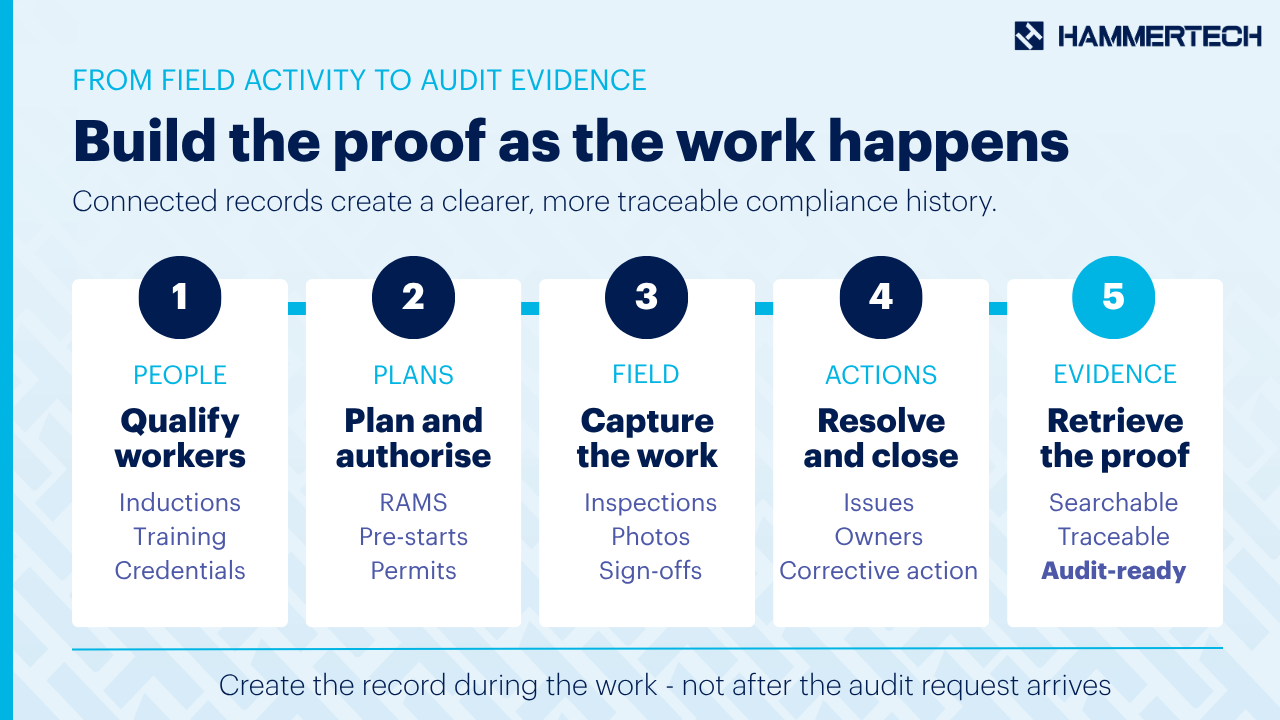
The goal is not to produce more paperwork. It is to create a clear, reliable way to demonstrate compliance and protect the business. For civil infrastructure audit readiness, that chain of evidence needs to exist before anyone asks to see it.
The Governance Challenge: Satisfying Transport Authorities, Regulators, Government Clients and Joint Ventures
On any large civil project, a general contractor sits at the center of a web of regulations, contracts, and project requirements.
You are not just building. You are coordinating workers, plant, subcontractors, permits and high-risk activities while helping ensure the project meets standards established by multiple authorities.
A highways, rail, water or energy authority may require specific competencies, permits, supplier-assurance records or project documentation. A local authority may impose additional conditions for road-opening, traffic or utility work. Public-sector clients, private asset owners and joint ventures may add further reporting, assurance and approval processes.
An HSE inspection, HSENI inspection, HSA inspection, client audit, infrastructure-authority review and joint venture assurance review are not interchangeable. The exact records requested will depend on the jurisdiction, contract, funding arrangement, project risks and purpose of the review.
In Great Britain, the Construction (Design and Management) Regulations 2015 establish defined duties for clients, designers, principal designers, principal contractors and contractors. HSE guidance says principal contractors must plan, manage, monitor and coordinate the construction phase, maintain a suitable construction phase plan, ensure workers receive site-specific inductions and verify that appointed organisations have the necessary skills, knowledge, experience and organisational capability.
Northern Ireland operates under the separate Construction (Design and Management) Regulations (Northern Ireland) 2016. HSENI describes the framework as requiring suitable planning, competent people, coordination, effective communication and worker engagement throughout construction work.
In Ireland, the client appoints a Project Supervisor Construction Stage to manage and coordinate safety and health during construction. Contractors must cooperate with the PSCS, provide relevant site-specific information, comply with the project’s safety and health plan, provide site-specific inductions and supply information required for the safety file.
That makes clear contractor safety documentation essential. Records may need to show which organisation was involved, what work was happening, who identified or controlled the risk, what corrective action was required and whether it was completed.
Each stakeholder may request specific information, including worker competencies, inductions, RAMS, construction phase plans or construction-stage safety and health plans, incident reports, permit histories, site-access records, inspection records or corrective-action close-outs. Trying to gather that information from scattered sources after an auditor calls is a recipe for stress and potentially adverse findings.
The goal is to remain consistently prepared, with safety documentation organised and accessible regardless of who is asking or why.
The Risk of Disconnected Systems and Project-by-Project Safety Tools
Many construction firms try to manage safety with a mix of spreadsheets, paper forms, and regional legacy systems.
On a single project, this might seem workable, if not ideal. But when you scale up to multiple civil projects - some spanning kilometres and others lasting several years - the gaps begin to multiply. Each project manager may adapt tools to the specific site, creating silos of information.
Fragmentation brings real risks. Safety data can become inconsistent, difficult to track, and even harder to audit.
Imagine an auditor asking for evidence that workers on a major road or rail project completed the required site induction, role-specific training and competency verification. If that information is buried in local files across different site offices, or worse, in handwritten logs, it becomes difficult to produce a complete, credible answer.
A disconnected system also makes contractor safety harder to manage. Subcontractors bring their own workers, competencies, processes and documentation. Without a standardised approach, it can be difficult to confirm that every team is following the same core protocols, reporting incidents consistently and maintaining current licences and qualifications.
A lack of centralised visibility leaves principal contractors exposed. It makes achieving civil infrastructure audit readiness a constant uphill battle rather than a built-in operational standard.
Building an Audit-Ready Field Safety Standard
The answer is standardisation and centralisation, supported by digital workflows designed for the field. This is not simply about collecting more data. It is about structuring that data so it is consistent, traceable, useful, verifiable and easier to retrieve during an audit or compliance review.
Centralizing Worker Orientation and Qualification Records
Every worker on a civil project needs the orientations, training, and qualifications required for the work they will perform.
That may include general site requirements as well as project-specific and task-specific training. A strong system centralises worker information so teams can review whether required inductions are complete and whether recorded licences, qualifications and competencies are current before work begins.
Imagine a worker arriving on site and the team being able to review their status immediately: induction complete, training recorded, documentation current and applicable requirements accounted for.
This visibility helps teams identify missing requirements before a worker begins high-risk work. On public-private partnership projects, the same records can also support PPP compliance by helping teams respond to public-sector, private-partner and project-specific requirements.
Creating Time-Stamped Inspection and Permit Histories
Paper forms are easy to lose, damage, or separate from the work they relate to.
Digital inspections can provide a time-stamped, more traceable record. When a site supervisor conducts a safety inspection, the record can show who completed it, when it occurred, what was found, and whether corrective actions remain open.
The same principle applies to permits. A digital permit can be connected to a defined work area or project zone, the responsible contractor and related RAMS, risk assessments or pre-start documentation.
This creates a clearer trail through the work:
-
What activity was authorised?
-
Where and when did it take place?
-
Who approved it?
-
Which workers or contractors were involved?
-
What hazards and controls were identified?
-
Was the work completed and the permit properly closed?
Relevant approvals, sign-offs, observed hazards, and corrective actions can become part of the project record. That makes it easier to show what happened, where it happened, and what the team did about it.
Retrieving Records for Audits and Compliance Reviews
The real test of an audit-ready system is whether it can answer a specific request without forcing the team to rebuild the story manually.
When an auditor asks for safety information, teams should not have to search through emails, spreadsheets, filing cabinets, and disconnected project folders.
A connected system makes it easier to retrieve incident reports for a particular period, RAMS or risk assessments for a specific activity, inspection records for a work zone, or worker orientations for an individual subcontractor. Depending on how the system is configured, teams may also be able to organize records by project, employer, worker, date, activity, or status.
This capability is important for maintaining consistent, retrievable contractor safety documentation, supporting due diligence, and improving civil infrastructure audit readiness without a last-minute scramble.
How HammerTech Supports Standardized, Field-First Governance
HammerTech understands the pressures principal contractors face across civil and infrastructure work. The platform helps contractors establish a consistent, auditable approach to safety across projects without disconnecting that standard from the realities of the field.
Subcontractor Management and Inductions and Worker Info bring employer information, worker records, training, competencies and documentation into centralised workflows.
RAMS, risk assessments and Safety Data Sheets can also be digitised and managed consistently. During construction, teams can manage pre-starts, permits and safety meetings digitally. Toolbox talks, permit approvals and worker sign-offs can be recorded in one platform.
Inspections, observations, incidents, site diaries and site-access information can then be captured to provide a clearer picture of what is happening across the project.
This means safety, compliance and field-operations data no longer have to sit in separate silos. Teams gain greater visibility across complex contractor networks, more consistent documentation and a clearer way to retrieve evidence when it is requested.
Less reliance on paper. Fewer gaps between projects. Less scrambling when someone asks for proof.
Instead, contractors can build a more consistent approach to civil infrastructure safety compliance - one that is visible, traceable and audit-ready.
Build the Proof as the Work Happens
When you are building the infrastructure that connects communities, your safety systems need to be as dependable as the structures you create.
Being audit-ready is not only about avoiding penalties or findings. It is about running a safer, more consistent, and more predictable operation. It means being able to review whether worker qualifications are current, high-risk work has been properly authorised, inspections are complete, and corrective actions have been closed.
Most importantly, it is having confidence that you can provide evidence of your commitment to safety to a regulator, infrastructure authority, client, local authority, asset owner or joint venture partner without launching a search for the paperwork.
Frequently Asked Questions
What challenges do main contractors face with civil infrastructure safety compliance?
Main contractors may need to satisfy requirements established by infrastructure authorities, HSE, HSENI, Ireland’s HSA, local authorities, public-sector clients, private asset owners, joint ventures and other project stakeholders. They must also coordinate workers and subcontractors across changing work zones and long project timelines. Maintaining consistent, retrievable documentation across these groups is a central part of civil infrastructure safety compliance.
How does HammerTech support civil infrastructure audit readiness?
HammerTech centralises worker and subcontractor records, inductions, training and competency information, RAMS, permits, inspections, corrective actions, incidents and site diaries. This helps contractors maintain a retrievable history of safety activity and assemble requested documentation more efficiently. Contractors remain responsible for configuring their processes to meet applicable legislation, contract, jurisdiction and project requirements.
What are the risks of using disconnected safety systems on large civil projects?
Disconnected systems can create missing, duplicated, outdated or inconsistent records across projects and subcontractors. They can also make it harder to verify worker competencies, determine which permits are active, track corrective actions and produce unified contractor safety documentation when a regulator, auditor, client or asset owner requests it.
How does HammerTech support multi-employer site safety and subcontractor management?
HammerTech provides centralised subcontractor profiles, company documentation, worker information, approval status, inductions, competency records and connected field workflows. Subcontractors can submit required documentation through self-service processes, while main contractors can monitor status across active projects. This supports more consistent safety administration and clearer visibility across complex subcontractor networks.