
%20GIF.gif?width=200&name=HammerTech%20Intelligence%20(HTI)%20GIF.gif)


The Compliance Trap
There is a version of FSC accreditation that many contractors quietly pursue: gather the documentation, pass the audit, file the certificate, move on.
It is a transactional view of what is, at its core, a performance-based framework.
The problem is that it does not hold up. Not under audit pressure. Not across multiple projects. And certainly not when something goes wrong on site.
Table of Contents |
A recent industry panel brought together Justin Bell- Director, Office of the Federal Safety Commissioner, Mick May- HSEQ Manager, GRC Buxton, and Mark Wright- Managing Director, FEFO Consulting.
What emerged across the conversation was a consistent message: the contractors who move through accreditation successfully - and maintain it over time - are not the ones who treated it as a compliance exercise. They are the ones who used it as a mechanism to build better organisations.
"If you have a company where safety isn't a 'tick-a-box' element, it's embedded in what you do - something that you want to improve and you want to make sure your workers come home safely every day - then you're going to do better with that cultural element embedded." ~ Justin Bell- Director, Office of the Federal Safety Commissioner |
That single observation frames everything else. Accreditation does not create safety culture. Safety culture creates the conditions for accreditation to mean something.
System Design: The Foundation that Everything Else Rests on
Before a single document is lodged with the OFSC, before a desktop audit is scheduled, the most important decision a contractor can make is understanding what kind of system they actually have.
Mark Wright frames this as a fundamental diagnostic question: is what you have a knockdown rebuild, or a renovator's delight?
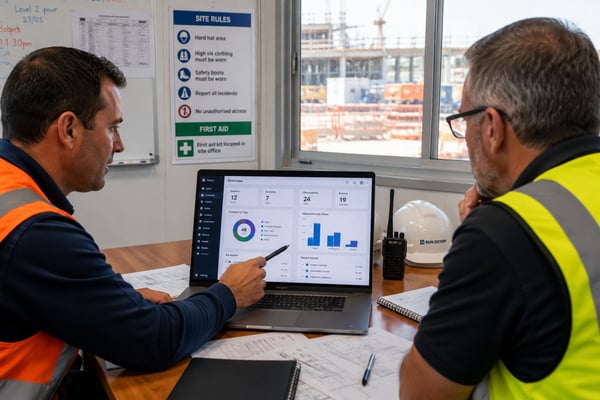
Getting that answer wrong is expensive. If the underlying architecture of your management system is flawed - if the document hierarchy is unclear, requirements are not properly mapped, or a single criterion contains multiple embedded obligations that have been overlooked - you can find yourself deep into the process before realising the design itself is working against you.
"If the fundamental design of the management system is not right, given the requirements are so high, you can end up tying yourself in a knot," Wright observed. "Understanding the right approach that suits your organisation is super important, and then getting the design of the management system right also enables the ease of implementation."
One of the most overlooked aspects of that design work is integration. Many organisations enter the process without fully appreciating what needs to connect - across quality, environment and business systems, and within the management system itself.
Change one element without understanding how it relates to others, and the knock-on effects can create a cascade of inconsistencies that auditors will find.
This is why mapping matters. Not just mapping your system against the FSC criteria for audit purposes, but understanding internally how your documents relate to each other. When you know that, you can make changes with confidence. When you do not, a single update can unravel more than you intended.
For GRC Buxton, that realisation shaped their entire approach. Mick May joined an organisation where the previous system had lapsed, with documentation scattered across desktops and inconsistent across the business.
Rebuilding with a clean architecture - one platform, one source of truth, controlled access - became the foundation for everything that followed.
Consistency is the Real Deliverable
One of the conditions of FSC accreditation is that companies agree to operate the same system across all sites where they are the head contractor. From the outside, that can feel like an imposition. From inside the scheme, it tends to feel like common sense.
Justin Bell noted that this perception shift is common among accredited builders: "Companies that are on the scheme consistently give us feedback that it makes sense to just have one system across their sites and that they appreciate working to the strongest standard."
Mick May echoed this from a practical standpoint. Before his appointment, GRC Buxton had people using paper versions, saving files to individual desktops, and operating without a shared standard.
The move to a single system - supported by a dedicated systems coordinator - changed not just how work was documented, but how people thought about doing the work.
"You don't want two systems. It makes it very difficult not only to manage it, but also for people on the ground to understand what good looks like," ~ Mick May- HSEQ Manager, GRC Buxton |
That last phrase is worth sitting with: what good looks like.
Consistency across projects is not bureaucratic standardisation for its own sake. It is the mechanism by which frontline workers develop a shared, reliable understanding of expectations.
When people move between sites and encounter a different system, a different form, a different process - even for the same task - the gap between what the procedure says and what actually happens, widens.
The contractors who maintain accreditation over time are the ones who solve for consistency not through enforcement, but through design. They make the right way the easy way.
Leadership Visibility is Not a Nice-to-Have
Ask most safety managers what gets in the way of a strong safety culture and they will often point to the same thing: leadership that is disconnected from what is actually happening on site.
The FSC accreditation process specifically looks for evidence of senior management commitment. But beyond the audit, leadership visibility is what makes a system function under pressure.
When senior leaders cannot see emerging risks before they become incidents, the system is already failing - quietly and invisibly.
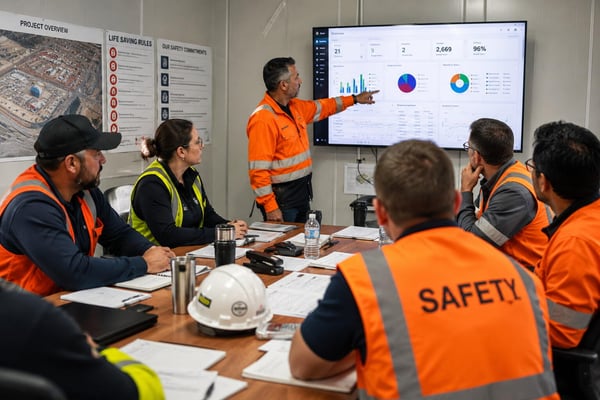
GRC Buxton addressed this through a structured look-ahead process. Project managers and site managers complete what May describes as a proactive planning checklist - a short, practical forward scan of what high-risk work is coming, what planning has been done, and where assistance might be needed.
That checklist flows directly to senior leaders and directors.
"So they've got visibility of what's coming up. And if there's any gaps or assistance they might need from the safety team - what's working well or not working well - they can actually see where that is," May explained. "Teams are actually reporting up so they understand where there might be any potential issues, whether they need assistance or things they've done well."
Justin Bell reinforced why that proactive posture matters to the audit process itself. Companies with senior management who are briefed, engaged, and visibly committed move through accreditation faster and with fewer issues.
Not because they have better paperwork - but because leadership involvement is observable. Auditors see it in how people talk about safety, in how quickly an organisation responds to requests, in the quality of the corrective actions that come back.
Mark Wright framed it as an enterprise-level obligation, not just a site-level one. The FSC criteria carries requirements both at project and company level, and working with senior managers on the quality of performance and assurance reporting is part of what makes accreditation sustainable rather than superficial.
What Strong Evidence Integrity Actually Looks Like
Perhaps no concept is more misunderstood in construction safety than evidence integrity. Many organisations equate it with volume - more forms, more signatures, more files.
The panel's view was more precise, and more demanding.
Strong evidence integrity means the record shows who did what, when, and how. It is specific. It is traceable. And it closes a loop.
Mick May described the standard his team holds when conducting task observations: "Put a worker's name. Who have you checked? Has he got a construction industry card? Has he got the high risk work licence? Have you checked when the plant's been serviced, what date was it? And then you can close that loop or if you've got a gap, then you can raise an observation."
That level of specificity is the opposite of a tick-and-flick approach. It reflects an organisation that is using its system to actually understand what is happening on site - not just to demonstrate that someone walked around.
Mark Wright offered a practical framework for getting there: processes need to clearly define who is responsible for an activity, when it needs to occur, and how it is done.
When those three elements are explicit, people know what is expected. When they are vague, the system fills with entries that look compliant and mean nothing.
The audit failure mode Wright sees most often is not dishonesty. It is documentation that is technically present but practically empty - process descriptions too high-level to test, records that confirm an activity happened but give no insight into how, corrective actions closed without evidence of follow-through.
Justin Bell brought it back to culture: organisations where safety is genuinely embedded produce evidence that reflects real engagement. The documentation becomes a by-product of doing the work properly, not a separate administrative exercise conducted in parallel with it.
Technology Enables - it Does Not Replace Foundations
There is a version of digital transformation in construction safety that does not work: organisations that identify their compliance problems, select a software platform, and expect the technology to solve the underlying issues.
Mark Wright is direct about where that leads.
~ Mark Wright- Managing Director, FEFO Consulting |
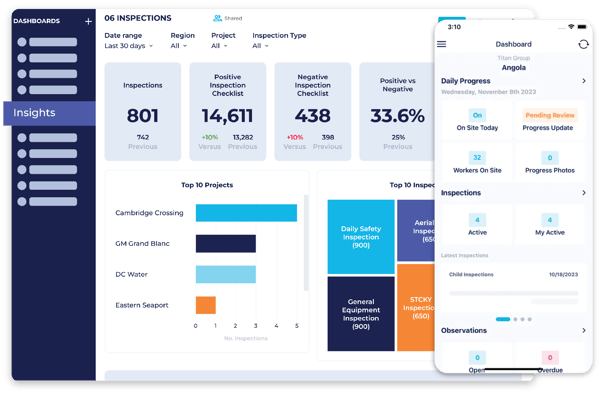
Technology is a multiplier. If the foundations are sound - if the system is well-designed, the documents are properly mapped, and the processes are clear - then digital tools can automate, connect and surface information in ways that meaningfully strengthen oversight.
If the foundations are not sound, technology accelerates the problems rather than solving them.
GRC Buxton's experience illustrates the right sequence. The discipline of building a single, consistent system came first. Control over what could be changed and by whom came second.
Technology then supported the consistency they had already committed to - making it visible, making it searchable, making it easier for people across the business to do the right thing.
"That's the only place you can get it from," May said of their centralised platform. "That's been the hardest change for people's thinking because they only know what they know."
The shift from distributed files and local habits to a governed, visible system is a cultural change as much as a technical one. The platform supports it. The platform did not produce it.
Keeping the System Alive: Continuous Improvement in Practice
Accreditation is not a destination. The organisations that struggle most in maintenance audits are the ones that treated getting accredited as the finish line.
Mick May is clear that safety systems are inherently dynamic: "In safety itself, it's never static because there's potentially legislation change, codes of practices, Australian standards, industry standards, ISO standards. There's a lot of things that do change or if there's been an incident. There's always learnings to have, to review your system and just make sure that it aligns."
At GRC Buxton, that dynamism is built into day-to-day practice. When a scaffold industry standard changed the maximum height of steps, the systems coordinator updated the relevant checklist. Suggestions from workers in the field - who often identify practical improvements before management does - are actively sought and tracked.
"Sometimes it might not be what they actually do, and then you can make certain changes and get them involved," May noted, speaking about engaging workers directly in refining procedures.
That point is a marker of genuine safety maturity. Organisations that only update their systems in response to audits or incidents are managing compliance.
Organisations that build feedback loops from the frontline, from data trends, from legislative changes, and from internal suggestions are managing improvement.
Justin Bell pointed to data as the instrument that makes this visible at scale. The FSC uses company engagement, audit results, and incident reporting together to form a risk rating that determines audit frequency. More risk, more scrutiny. Demonstrated improvement, less.
For individual organisations, the principle is the same: if you are using data to understand where your system is working and where it is not, you are ahead of the vast majority.
Practical Questions for Safety Leaders
The panel discussion surfaced a set of principles that translate directly into questions any safety leader should be asking about their organisation:
On system design:
-
Is our management system built on a clear, documented foundation - or has it accumulated layers over time without a coherent architecture?
-
Do we know how our documents relate to each other, and what the knock-on effects of a change in one area would be?
-
Have we mapped our system against the FSC audit criteria in a way that both our team and an auditor can navigate?
On consistency:
-
Would a worker moving between two of our sites experience the same system, the same expectations, the same standard?
-
Is there one authoritative source for our safety documents, or are there competing versions in circulation?
On leadership visibility:
-
Can our senior leaders see what is coming up across projects before risk materialises?
-
Does leadership engage with safety data as a management tool, or does it surface only after incidents?
On evidence integrity:
-
Do our records show who, what, when and how - or do they confirm that a box was checked?
-
If an auditor followed the trail of a corrective action from identification to closure, would the evidence hold up?
On continuous improvement:
-
When did we last make a meaningful change to our system based on worker feedback?
-
Are we tracking trends in our data - not just totals - to identify where performance is drifting?
Conclusion
The contractors who achieve FSC accreditation most cleanly - and who maintain it over time without scrambling before each audit - are not the ones with the most documentation.
They are the ones who built systems that actually work, led by people who are genuinely engaged, and supported by cultures where safety is how the work gets done - not an additional layer placed over it.
FSC accreditation is a rigorous, externally verified test of whether that is true in practice. Scheme-accredited builders have less than half the fatalities of the broader industry. Workers' compensation premium rates fall over time for companies in the scheme.
Those are outcomes, not coincidences. They reflect the quality of what has been built underneath.
The goal is not the certificate. The goal is the capability the certificate proves you have.
Build the system. Engage the leadership. Develop the culture. The accreditation follows - and so do safer sites, more consistent operations, and better performance over time.
The best safety organisations never stop asking whether they can do it better. That question, asked honestly and acted on consistently, is what separates the leaders from the rest.
This article draws on insights from the HammerTech webinar featuring Justin Bell (Director, Office of the Federal Safety Commissioner), Mick May (HSEQ Manager, GRC Buxton) and Mark Wright (Managing Director, FEFO Consulting).
.png)